
Tools

There are few subjects as fundamental in gemology as lighting. By lighting, we mean not only natural light or artificial light, but also the way in which the stone is illuminated.
Let’s start with daylight. White light is made up of an infinity of different wavelengths which decompose according to the colors of the rainbow.

Depending on where you are on the globe and the time of day, this composition varies slightly. This explains why a ruby will look prettier in Asia than in Paris, and even prettier in the morning when the sun’s rays are still a little pink. Daylight is the main light source in the field.
Artificial light is much more complex to understand because depending on the type of lamp used, there may be missing wavelengths and others that are reinforced. For example, an (old fashioned) filament flashlight will emit across almost the entire visible spectrum of the rainbow, but will strongly enhance red. In contrast, an LED lamp will not emit on the full spectrum and will have absorption areas (holes) in the spectrum. You have just understood why we do not use an LED lamp with a spectroscope, which only breaks down the ray of light which has passed through a gem… We have the same absorption phenomenon with low consumption bulbs.
Some lamps have a wide and full spectrum and are called “daylight”. They are the ones that should be favored in the office, especially if you want to do color gradation.
Now let’s see how to illuminate the stone to be analyzed.
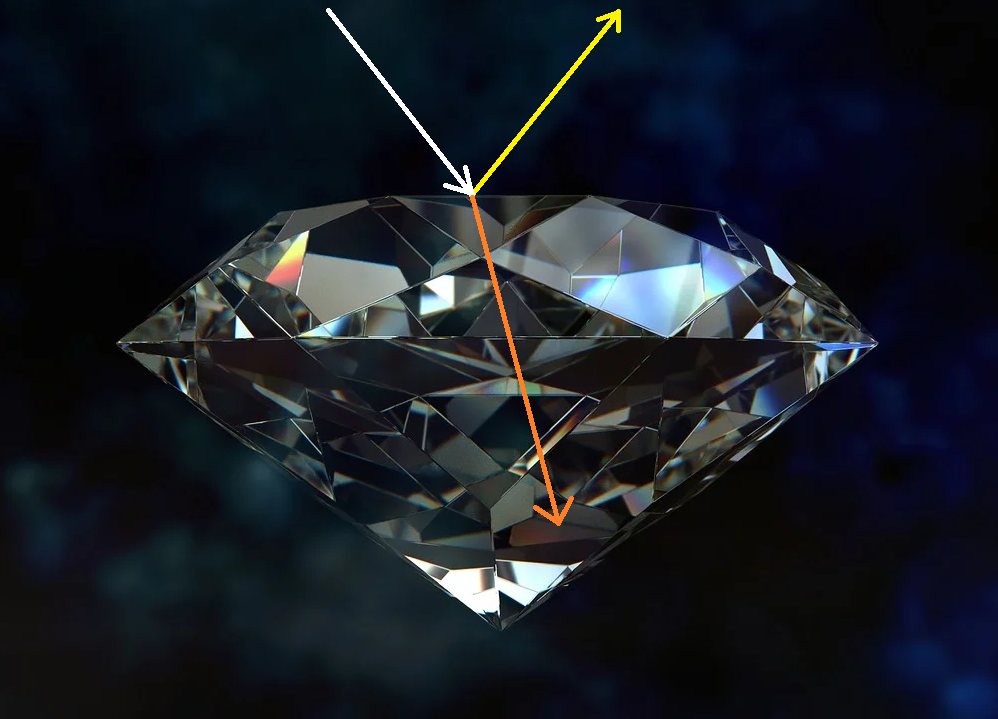
The illustration above shows us the three key concepts of lighting. In white we have incident lighting or incident light. It is the way in which the light source illuminates the stone. In yellow, we have the reflected light. It is the same principle as the mirror. The orange arrow materializes the transmitted light, that is to say that which passes through the stone. This is what we see when we observe a lamp through a gem. These three concepts are simple, but all observation in gemology is based on their mastery.
If we take the initial observation of a gem, we start by looking at the outside. We can observe scratches, breaks, etc. It is the reflected light that makes it possible to see these defects on the surface. As for inclusions, it is by observing the transmitted light that this is made possible. Indeed, if no light entered the stone, it would appear to have mirrored facets. And if no light was reflected on the stone (total absorption), then the stone would appear quite black to us.
In gemology, we mainly use transmitted light (we look into the gem). Here are the different ways to orient and use the light source.

Direct lighting is that which is used naturally by placing the stone between the light source and the eye. It has the advantage of ease, because we use a lamp or the sun, without any other instrument. Its main drawback is to dazzle the observer because we are looking straight at the light source.

Diffused lighting is the same as direct lighting, but a filter is placed between the light source and the gem. This is often the case when the light source is very strong. This allows the observation of very fine inclusions. Conveniently, it suffices to put a piece of white sheet or a tissue on the light source in order to reduce its intensity.

Side lighting largely prevents glare. There are still some light reflections on the facets of the crown. A particularly practical method is to hold your lamp vertically and place the stone directly on it (on your table or on the side of the breech). The lamp is then raised to eye level.


The lighting on a black background is the most relaxing for the eyes. At no time does the light reflect directly on the stone. With this lighting, one has the impression that it is the stone which is lit. It is this system that is used on gemological microscopes and on the dark field magnifier.

The last type of lighting is lighting with an immersion cell. You can use direct, diffused or side lighting, the only difference is that the stone is immersed in an immersion liquid whose refractive index is close to that of the stone. With this method, all angles and facets of the stone become blurred. The whole interior of the stone becomes easy to observe. This technique requires a relatively expensive horizontal gemological microscope, as well as the use of highly toxic immersion fluids. It is also possible to place a polarizing filter on either side of the immersion cell to reveal certain inclusions which are otherwise invisible.

To go further
- gemologist’s loupe
- tweezers
- darkfield loupe
- the polariscope
- the dichroscope
- the spectroscope
- Chelsea filter and other filters
- the refractometer
- the microscope
- UV lamp
- the carat balance